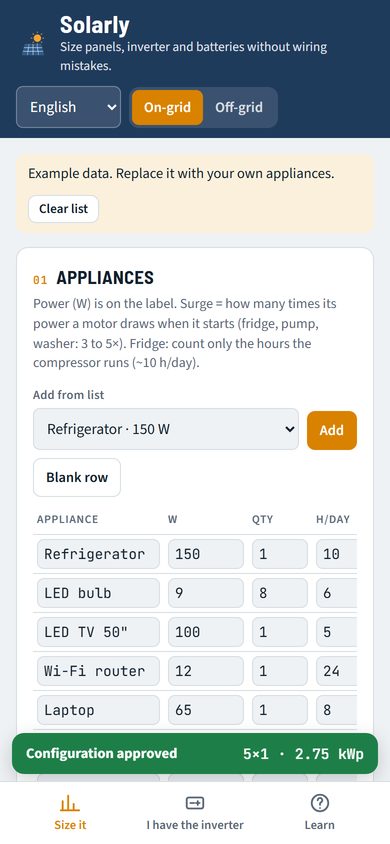
List your appliances and Solarly works out how many panels you need, which inverter fits and how to wire them in series or parallel. Already have an inverter? It shows everything that fits it.
Fridge, air conditioner, pump: add up usage and motor surge, then get panels, inverter and battery bank for on-grid and off-grid.
I have the inverter
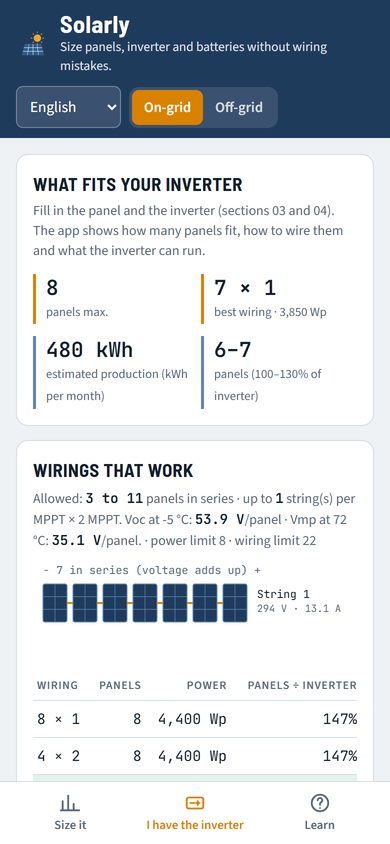
Enter your inverter and panel data. The app lists every wiring that works (series × parallel), the maximum power and the ideal range.
A report before you buy
Cold voltage, hot MPPT range, current per MPPT, DC/AC ratio, start-up surge and battery bank: each item gets OK, check or error, with the reason.
Learn
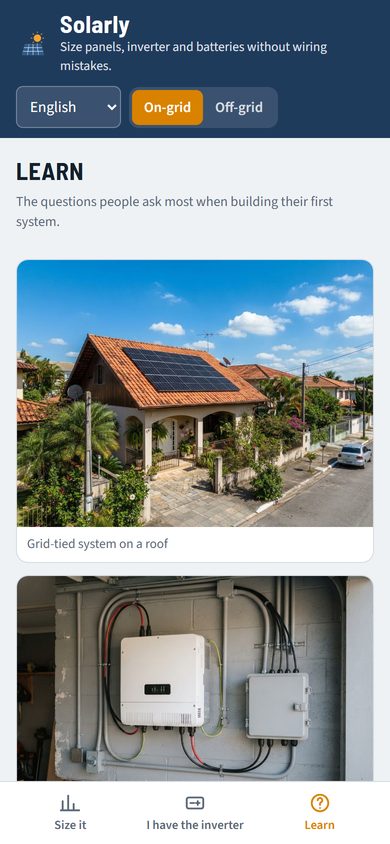
Series or parallel, MPPT, the panel label, 12/24/48 V, protection, shade and microinverters, explained with drawings.
How it works
Pick on-grid or off-grid and list your appliances.
Pick your city: the app uses its sun hours and yearly temperatures.
Enter the panel and inverter data (label and datasheet).
Read the report and adjust series × parallel until everything is green.
App screens
In the real world
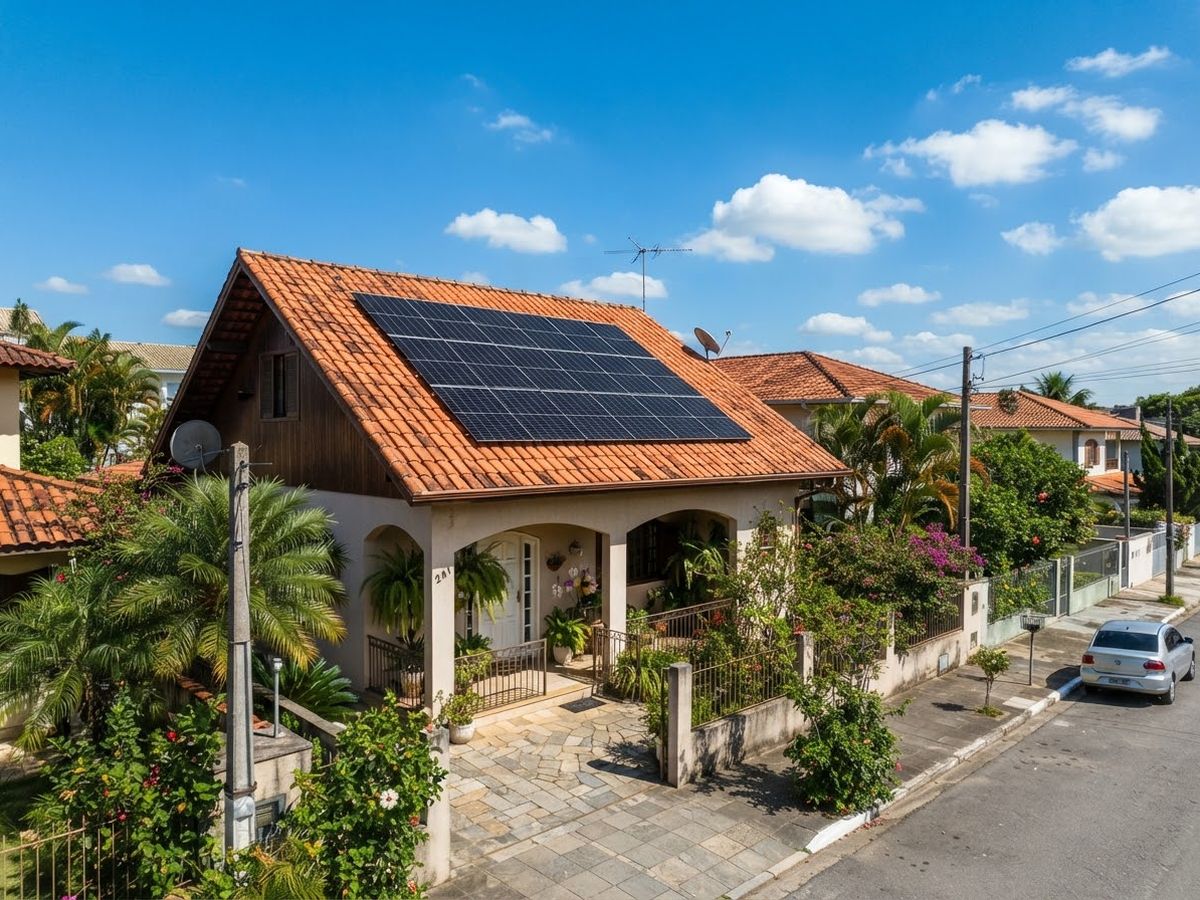
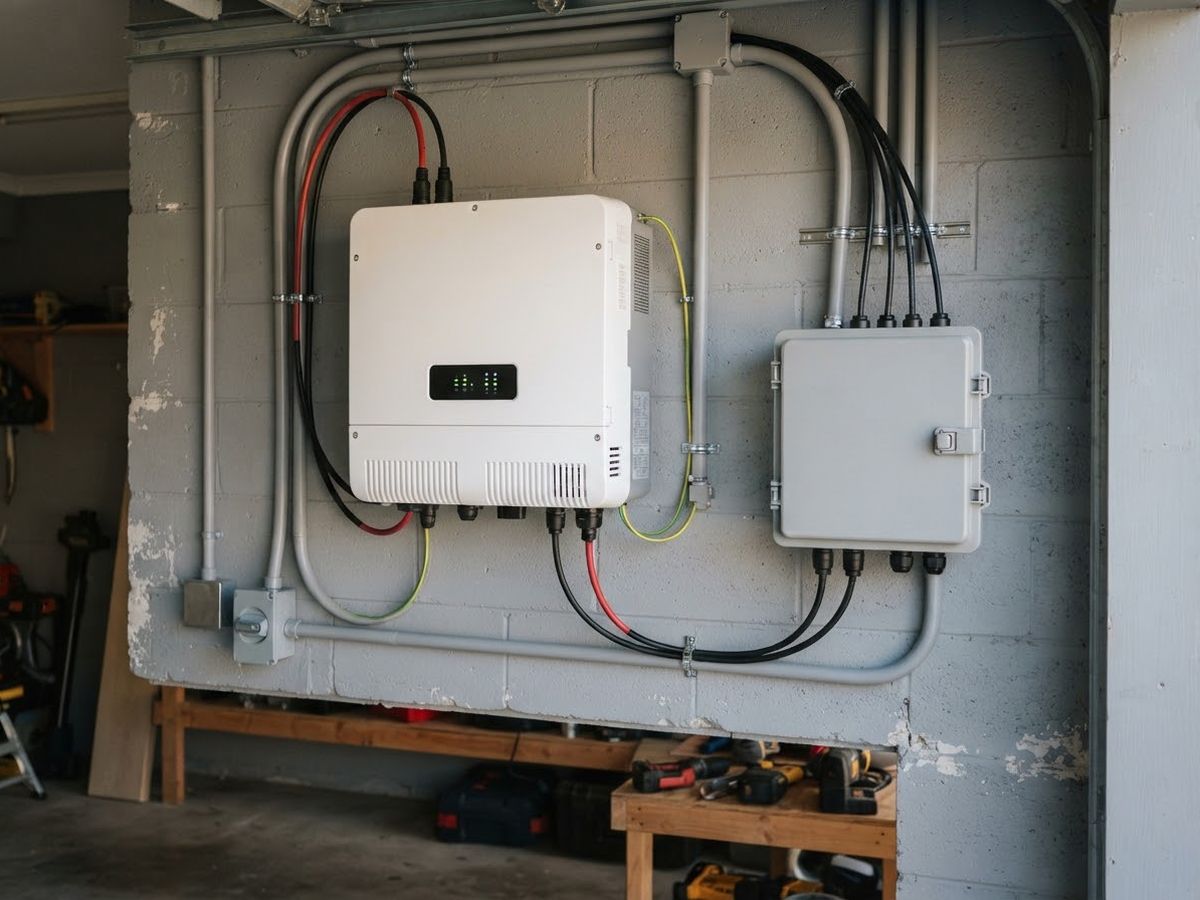
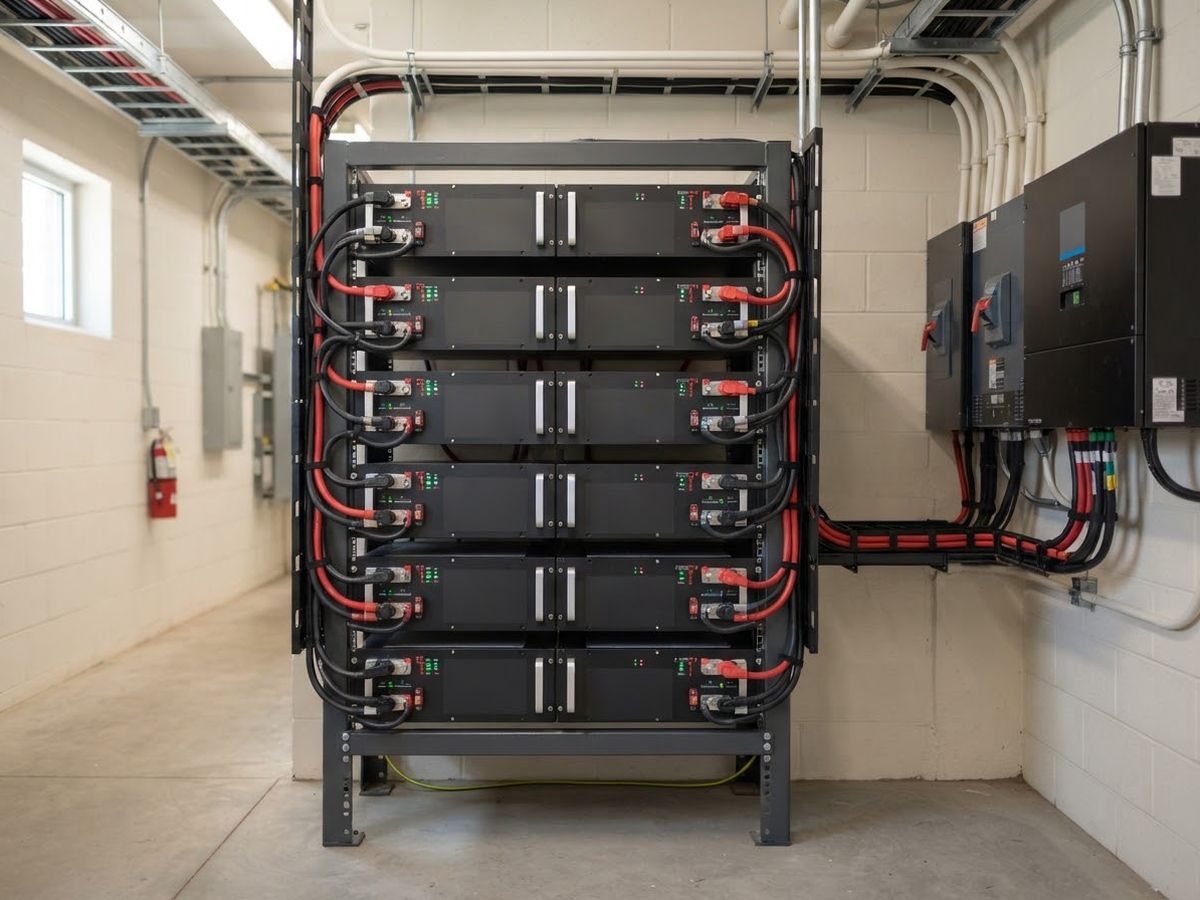
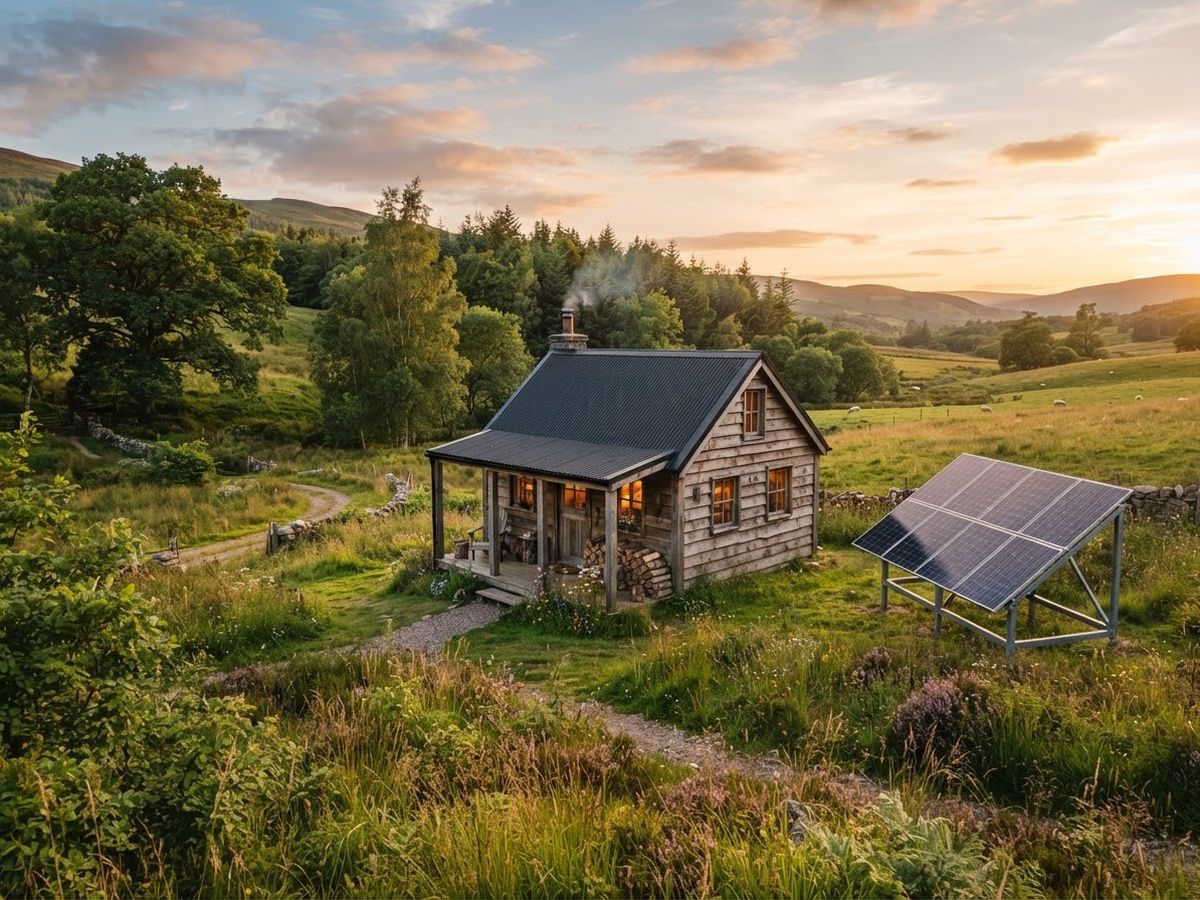
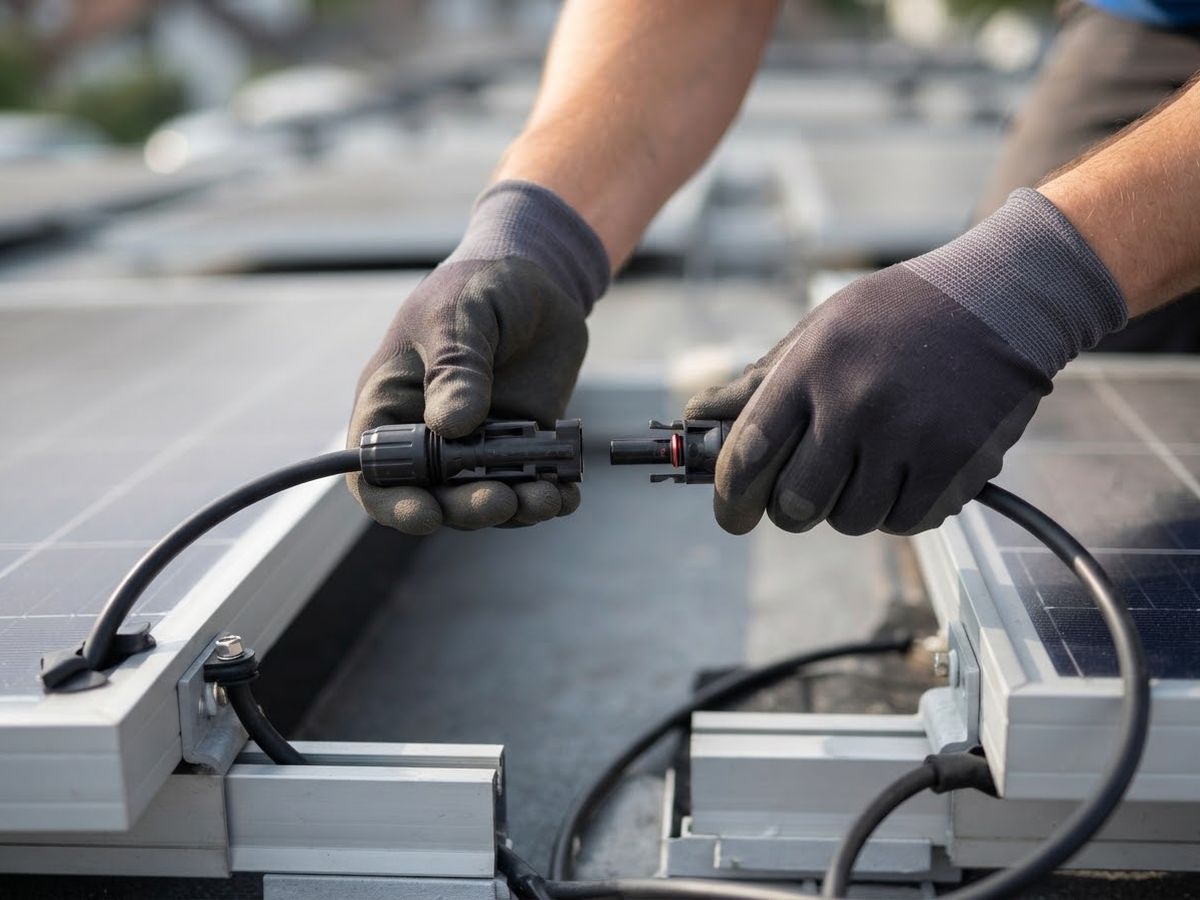
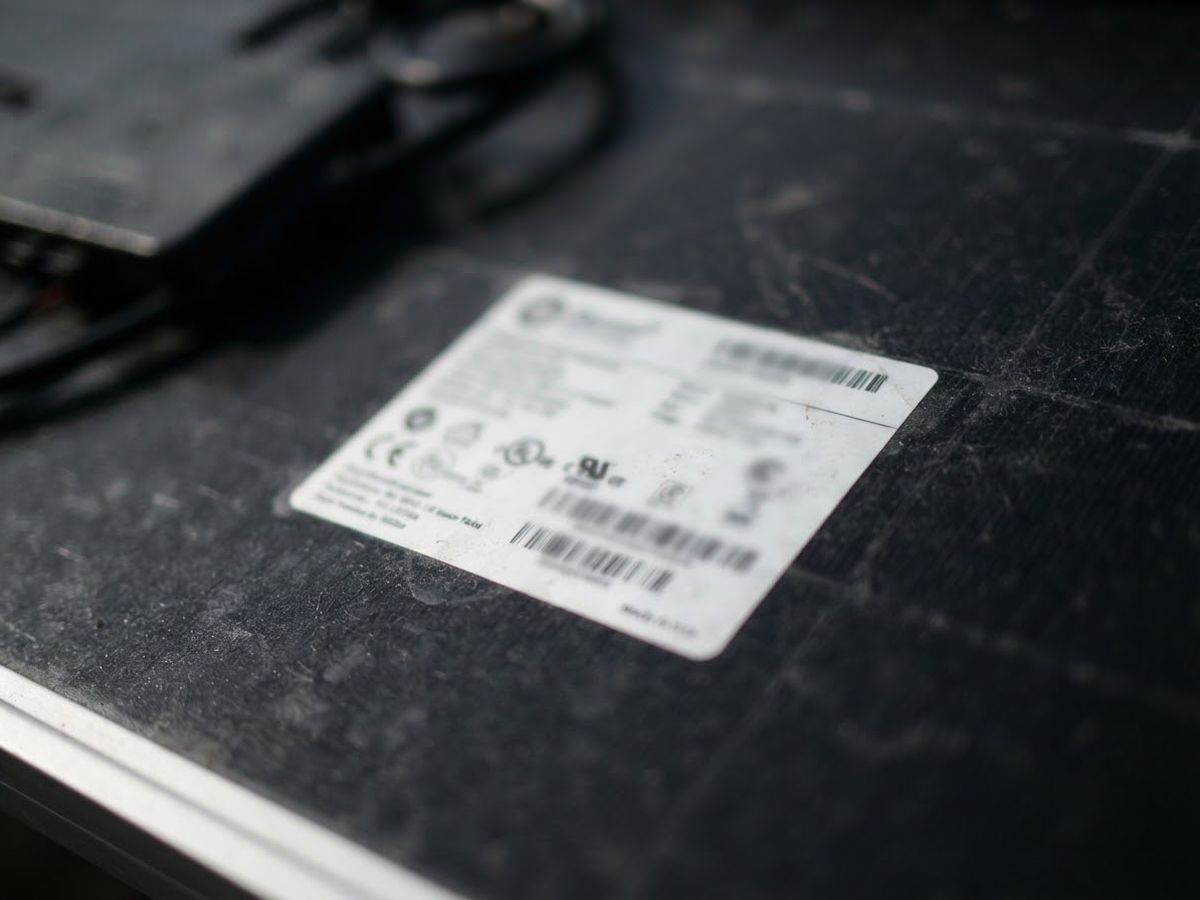
Grid-tied system on a roofInverter and combiner boxLithium battery bankOff-grid homeMC4 connectors in seriesPanel spec label
Frequently asked questions
On-grid, off-grid or hybrid?
On-grid connects to the utility and cuts your bill: no battery, it shuts down during a blackout. Off-grid runs alone on batteries: for cabins, farms or places without a grid. Hybrid does both: lowers the bill and keeps the house running from batteries when the grid fails.
What happens in series?
In series (+ of one to − of the next) voltages add up and current stays the same. Four 42 V panels give 168 V at 13 A. This is the normal way to feed an inverter: thinner cable, less loss.
And in parallel?
In parallel (+ to +, − to −) currents add up and voltage stays the same. Three 13 A strings give 39 A. Use it when a longer series would exceed the max voltage, or on 12/24 V systems. Watch the MPPT current limit (max. Isc).
What is the MPPT range?
It is the voltage window where the inverter can draw the most from your panels. The string must stay inside it in the heat (voltage drops) and never exceed the max voltage in the cold (voltage rises). Outside the window: lost production. Above the max: damage.
How do I read the panel label?
Voc = open-circuit voltage (use it for the max limit). Vmp = operating voltage (use it for the MPPT range). Isc = short-circuit current (use it for the MPPT current limit). Imp = operating current. The β coefficient tells how much voltage changes per degree.
Why can cold weather destroy the inverter?
Panel voltage rises in the cold: at −5 °C a 49.9 V panel goes above 54 V. In an 11-panel string that becomes 595 V, close to a 600 V limit. In the heat (panel at 70 °C) voltage drops up to 16%. That is why the app uses the lowest and highest temperatures of the year.
Can I install more panel power than the inverter rating?
Yes, and it is common: 100% to 130% (DC/AC ratio). Panels almost never deliver their rated power, so the inverter runs fuller all day. Above that, it clips the midday peak. Always respect the "max. DC power" and the current limit on the datasheet.
I already have the inverter: how many panels fit?
Use the "I have the inverter" tab. It takes the max voltage, MPPT range, current limit and DC power of your inverter and lists every wiring that works (panels in series × strings), with the power of each. For off-grid it also shows how much load it can run.
Off-grid: who does what?
Panels charge the battery through the MPPT controller. The inverter turns battery voltage (12/24/48 V) into 120/230 V for the house. There are three separate limits: panel side (controller voltage and current), battery charging (charge current) and house side (inverter continuous and surge power).
How do I build the battery bank?
Series raises voltage: four 12 V = 48 V. Parallel adds capacity (Ah). First match the inverter voltage in series, then add rows in parallel for the kWh you need. Use identical batteries of the same age, and equal-length cables on each row.
12, 24 or 48 V?
Same power, less current: 3,000 W draws 250 A at 12 V and only 62 A at 48 V. High current needs thick cable, heats up and wastes energy. Rule of thumb: up to ~1,000 W, 12 V; up to ~3,000 W, 24 V; above that, 48 V.
Why does the fridge trip the inverter?
A motor draws 3 to 5 times its power for a split second at start-up. A 150 W fridge asks ~600 W when it starts. An off-grid inverter needs a "surge power" above everything running plus the start-up of the largest motor. Low-frequency inverters handle this better.
Which protections are required?
DC side: matching MC4 connectors, a combiner box with fuses (when strings run in parallel), surge protection and a DC isolator. AC side: breaker and surge protection in the panel. Proper solar cable (1.5 kV DC). Your installer handles this, but it helps to know what to ask for in a quote.
Two roof faces or shade?
Panels with different sun on the same string drag each other down. Put each roof face on its own MPPT (east on one, west on the other), with equal-length strings within each MPPT. With heavy shade, microinverters or optimizers work better.
Microinverter or string inverter?
Microinverter: one unit per 1 to 4 panels, low voltage, each panel works on its own. Good for shaded or multi-face roofs; costs more per kWp. String: one inverter for all panels in series, cheaper and simpler to maintain. This app sizes string inverters.
 Solarly